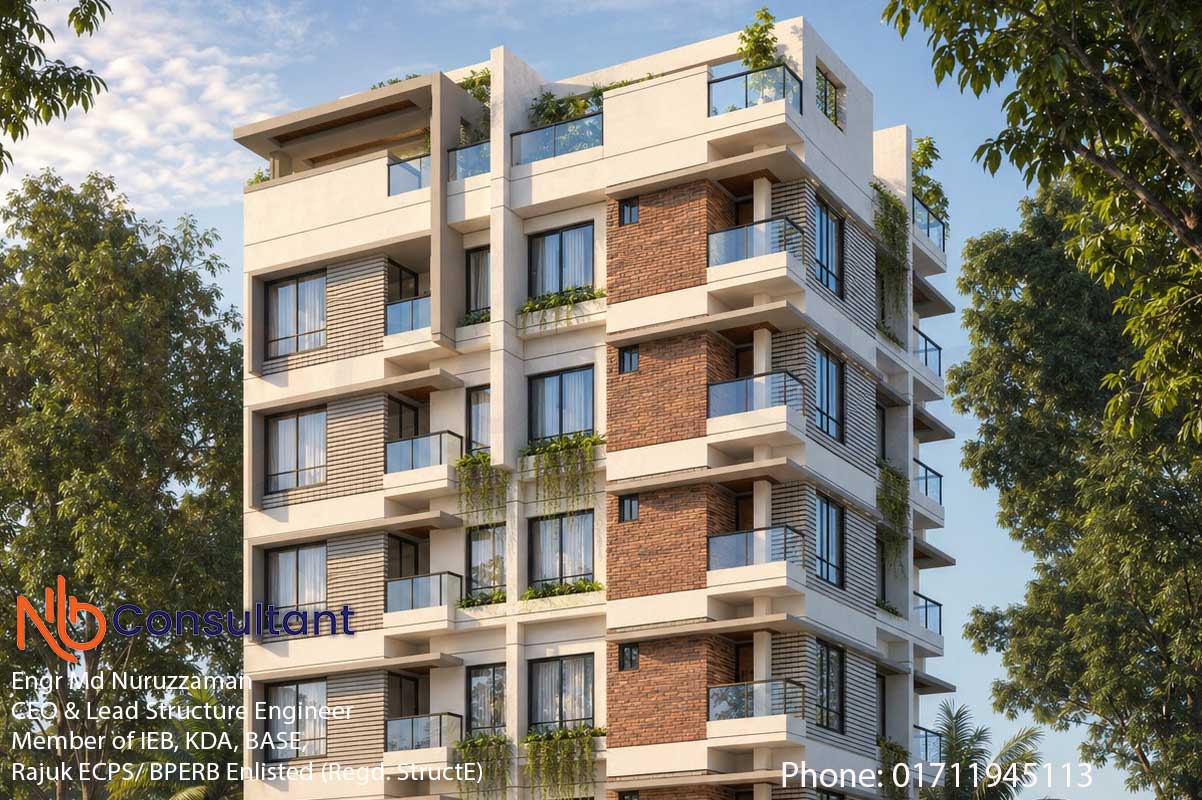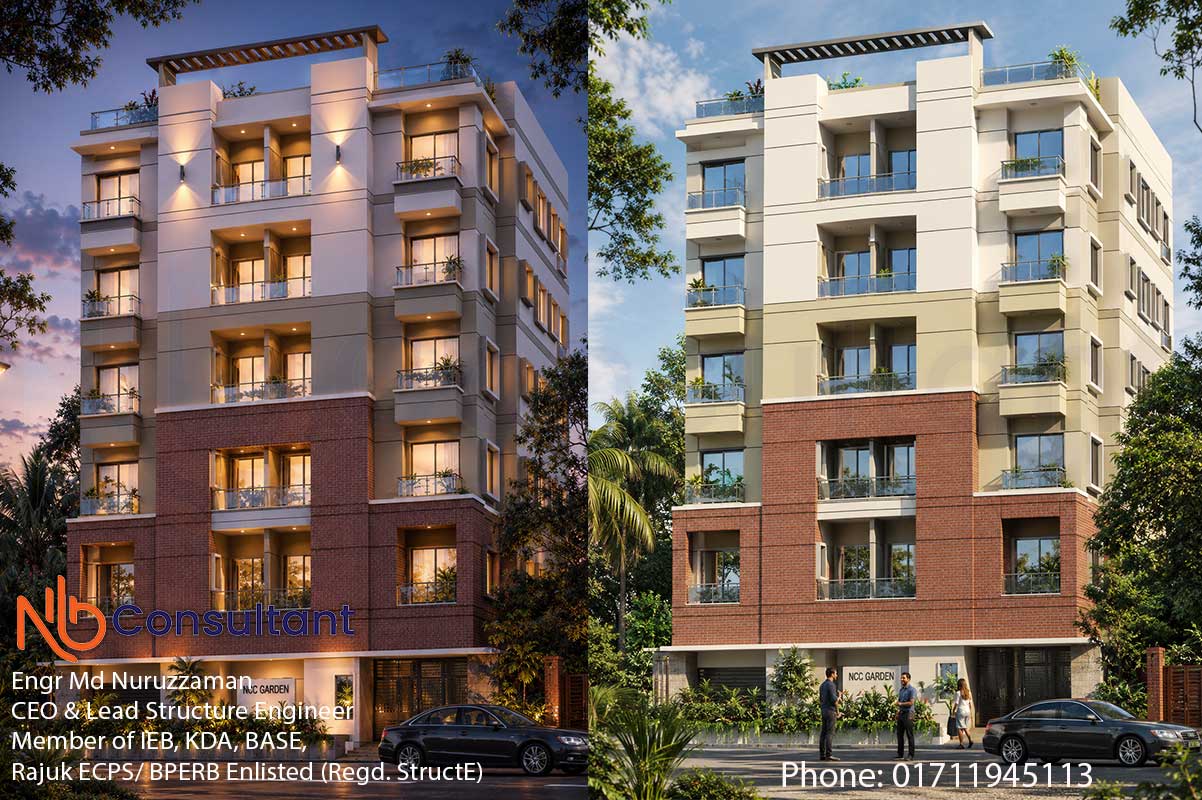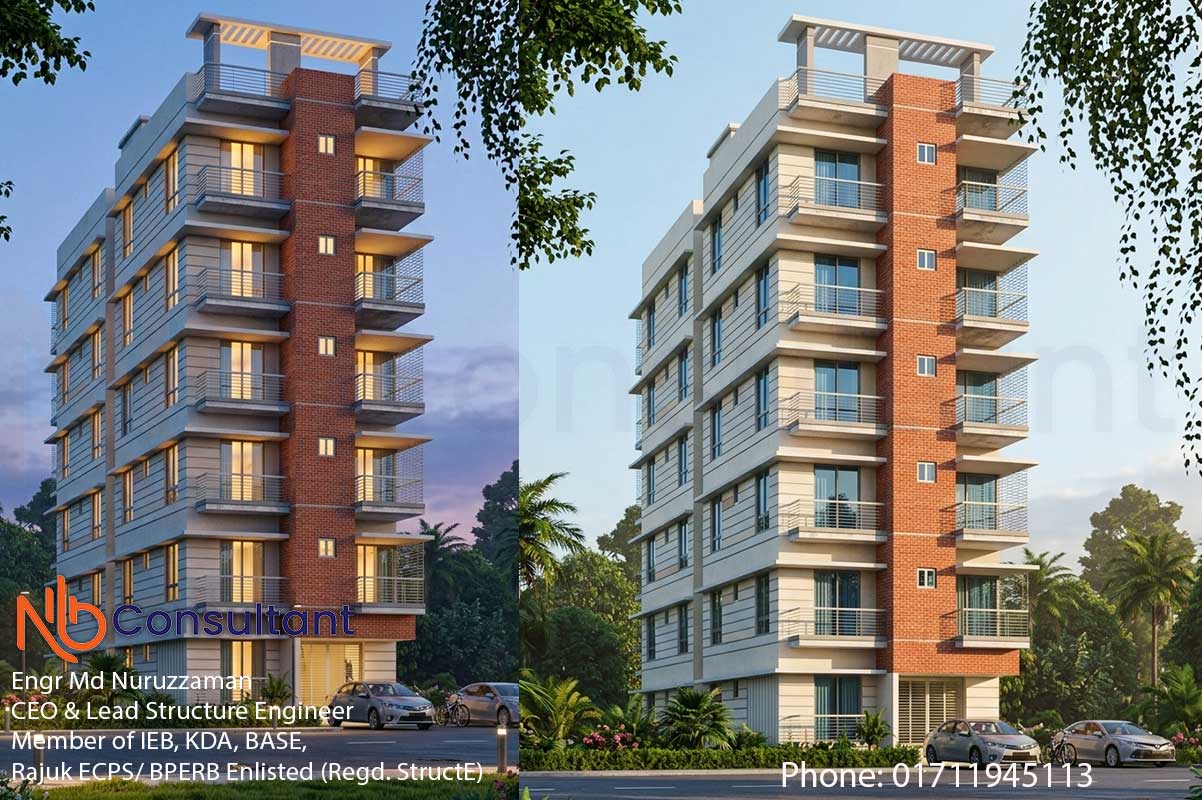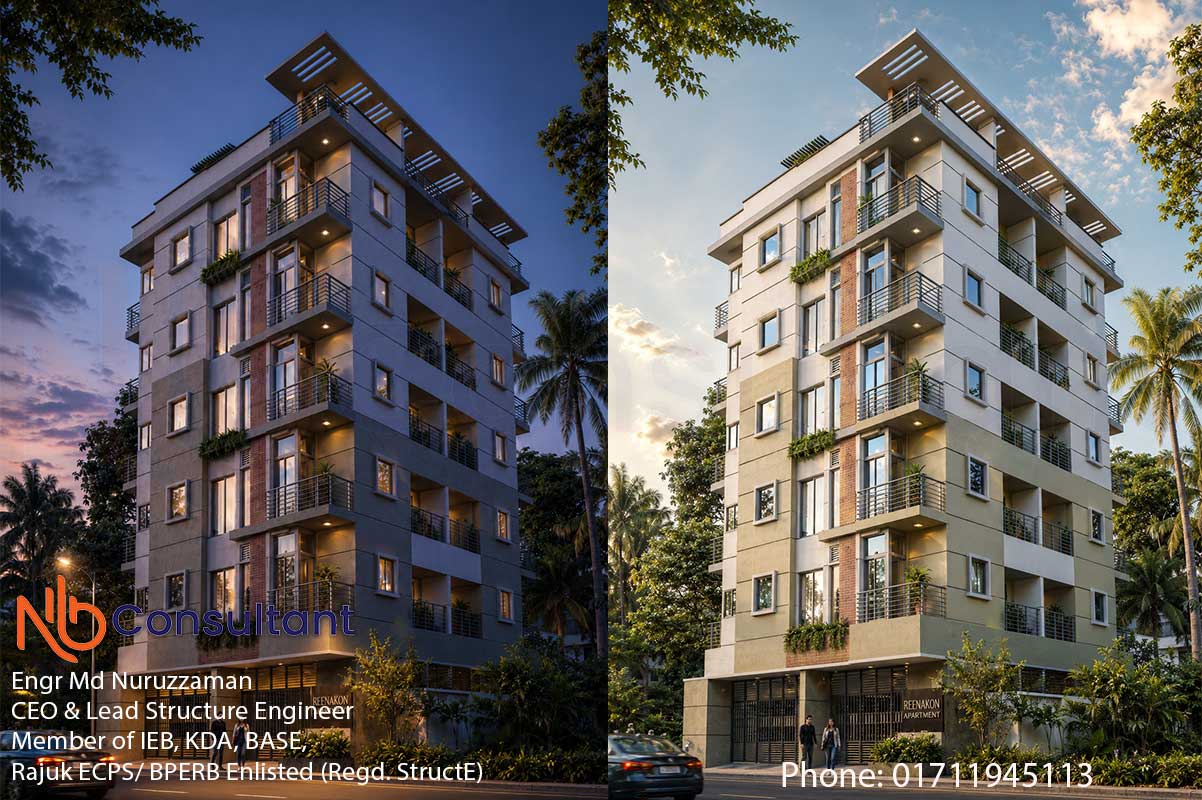

6 Storey Building Design in Bangladesh
6 Storey Building Design in Bangladesh
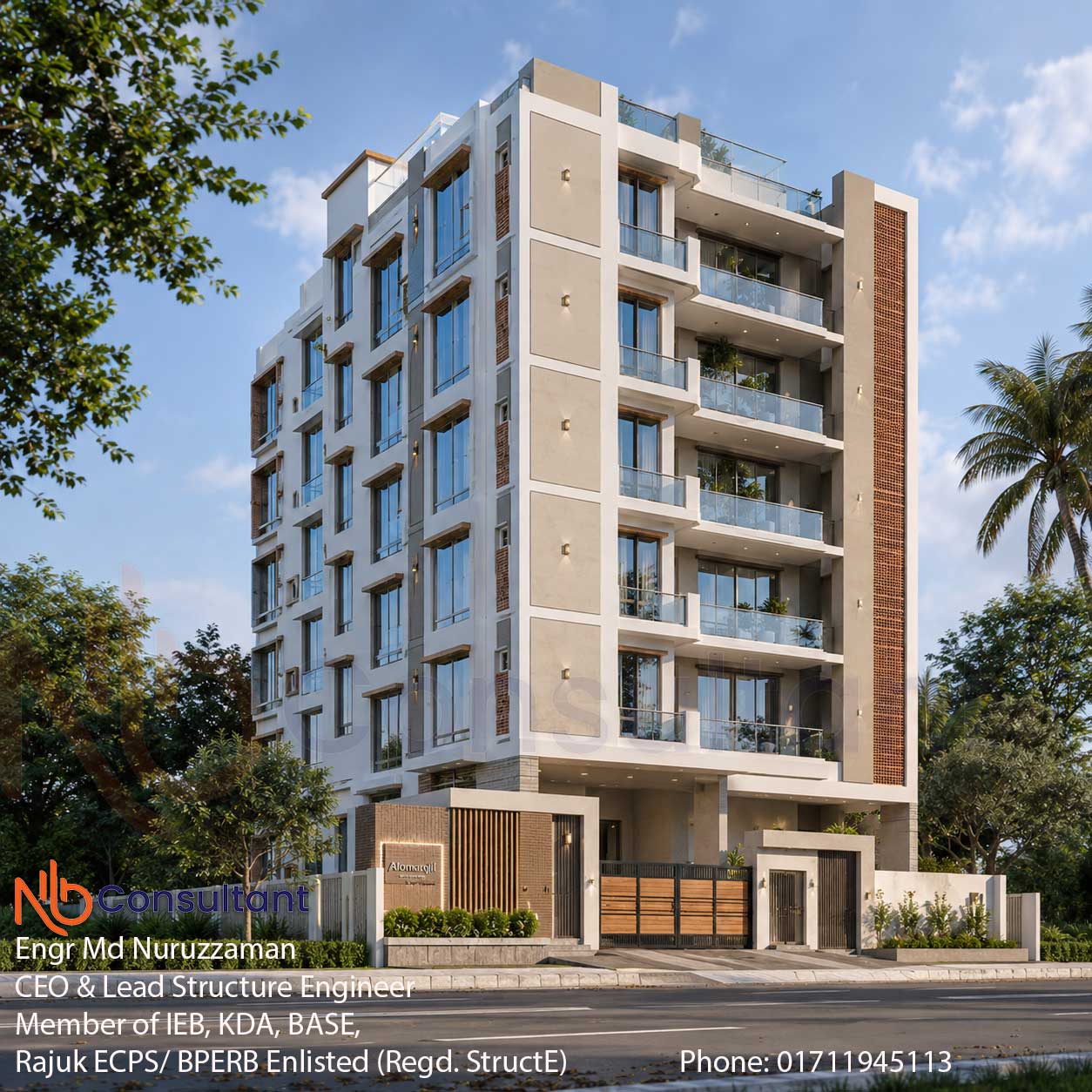
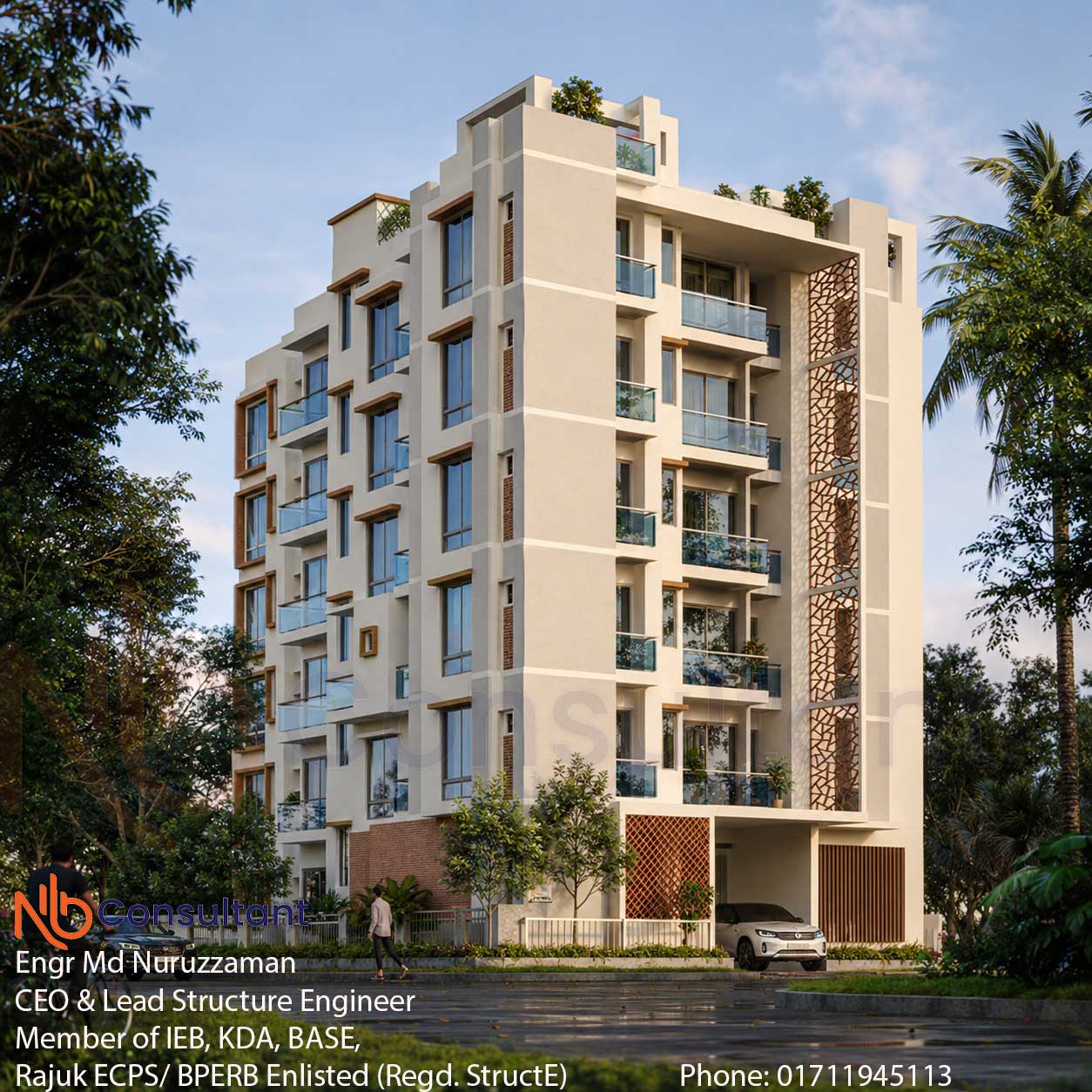

Master Guide: 6-Storey Building Design in Bangladesh
Design, Planning, and Regulatory Insights for Vertical Living
As urban centers across Bangladesh, particularly Dhaka and Chittagong, experience unprecedented rapid density and population growth, the demand for residential and commercial space has gone vertical. Single-family homes are giving way to mid-rise multi-unit buildings, and the 6-storey (G+5) format has emerged as a particularly popular and efficient configuration. This master guide is designed for landowners, developers, and architects embarking on this specific vertical journey, offering a deep dive into the nuances of design, planning, and executing a successful 6-storey building project.
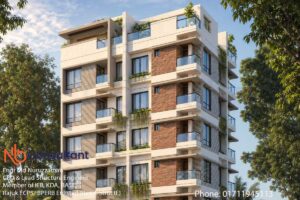
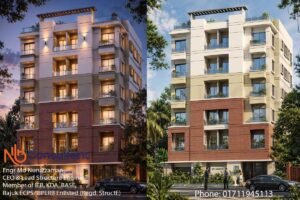
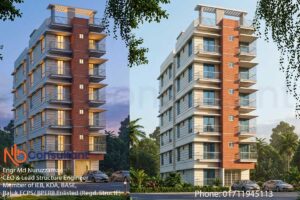
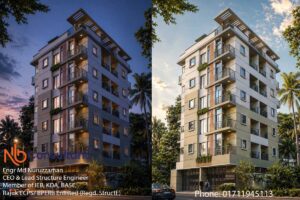
To illustrate these principles and showcase a high-quality visualization process, this article will reference a series of detailed design diagrams and visualizations based on a modern residential project.
Part 1: The Context of Vertical Growth in Bangladesh
The proliferation of 6-storey buildings in Bangladesh is not coincidental; it is a direct response to a unique set of urban challenges and opportunities.
Urbanization and Density: Bangladesh has one of the highest population densities globally, and a significant portion is concentrating in urban areas. This creates extreme pressure on land. To house more people on the same footprint, the solution is vertical. The 6-storey building strikes a balance, providing significantly more units than a single bungalow while remaining below the threshold of high-rise complexity. It fits well within established neighborhood scales.
Land Availability and Value: Land is a finite resource, especially in core cities like Dhaka. As land values soar, maximizing the Gross Floor Area (GFA) on a given plot is a financial imperative. A 6-storey building optimizes this for standard plot sizes (e.g., 3-5 Katha), making multi-unit projects economically viable for both developers and small landowners who partner with them.
Socio-Economic Shift: The rising middle class is seeking modern, secure, and amenity-rich housing. The modern 6-storey apartment building, with its common facilities, security, and proximity to services, offers a desirable alternative to older, scattered low-rise options.
Mix-Use Applications: While primarily residential, the 6-storey format is increasingly popular for mixed-use developments, often with commercial units on the lower levels and apartments above. This maximizes income for the landowner.
Part 2: Foundational Principles of a Successful 6-Storey Design
Designing for vertical living is vastly different from designing a single home. The design must handle increased loads, complex circulation, fire safety, and the optimization of shared spaces.
Key Design Priority: Maximize Light and Air One of the most critical aspects of dense urban design is ensuring sufficient natural light and ventilation for every habitable space. This becomes significantly more challenging in a 6-storey block. Good design must prioritize the use of light wells and cross-ventilation.
Visual Insight: Panel 6 “BUILDING MASSING & SUSTAINABILITY” of the referenced visual sequence shows a full 6-storey isometric view. You can clearly see how the building massing is shaped, creating pockets that are open to the sky (light wells). Note the small internal courtyards integrated into the floor plan structure, ensuring the inner rooms don’t rely only on peripheral windows.
Efficient Core Planning: The vertical core—stairs and elevator(s)—is the heart of the building. Its efficient placement is critical to floor plan usability. For 6 storeys, a single elevator is standard, but the core must also incorporate two or more stairways for code compliance and efficient flow.
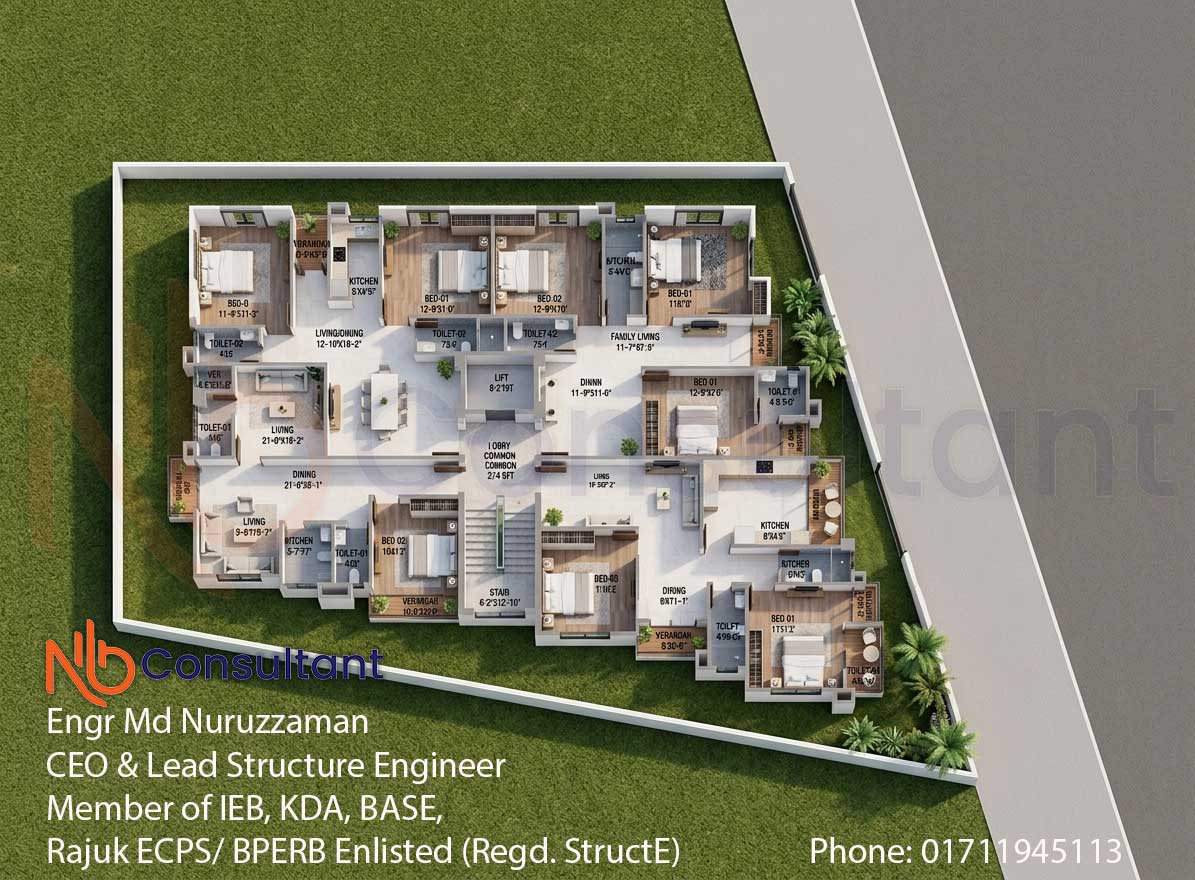
Visual Insight: Panel 2 “GROUND FLOOR DESIGN” and Panel 3 “TYPICAL FLOOR LAYOUT (UNITS A & B)” both clearly define the central “STAIR & LIFT CORE”. You can see how this core is centrally located to minimize corridor lengths to individual units (Units A and B). This is a textbook example of efficient vertical core design.
Part 3: Regulatory Compliance and Zoning (Bangladesh Specific)
In Bangladesh, all building designs must conform to the Bangladesh National Building Code (BNBC), which was extensively updated in 2020. This section outlines key BNBC considerations for a G+5 structure. Consulting a RAJUK (Dhaka) or CDA (Chittagong) registered architect is non-negotiable.
Minimum Setbacks: The BNBC mandates specific setbacks on all sides of the plot to provide light, air, and fire separation. The rules are complex and depend on the plot size and road width. For a typical 3-5 Katha plot and a standard residential road, general setbacks might be in the range of:
-
Front: 1.5 – 2.5 meters
-
Sides and Back: 0.6 – 1.2 meters
Visual Insight: Panel 1 “SITE AND CONCEPT” of the visual series highlights this. It shows a simplified site plan with the text: “CONTEXT: Urban Density, Corner Plot”. A corner plot can sometimes offer advantageous setbacks or corner radii, which a savvy architect will leverage.
Floor Area Ratio (FAR): FAR is a zoning control that limits the total GFA that can be built on a plot. A 6-storey building must fit within the FAR allowed for its zone. This often requires careful floor area allocation and sometimes makes a full 6th floor (the 5th floor above ground) a challenge on smaller plots, leading to stepped floor plans or reduced upper floors. Efficient design must prioritize net usable area within these constraints.
Ground Coverage and GFA Allocation: The total plot coverage is also limited. The remaining unbuilt space contributes to landscaping, parking, and setbacks. Design diagrams must clearly show how the ground is partitioned for these functions.
Part 4: A Typical G+5 Layout, Zone by Zone
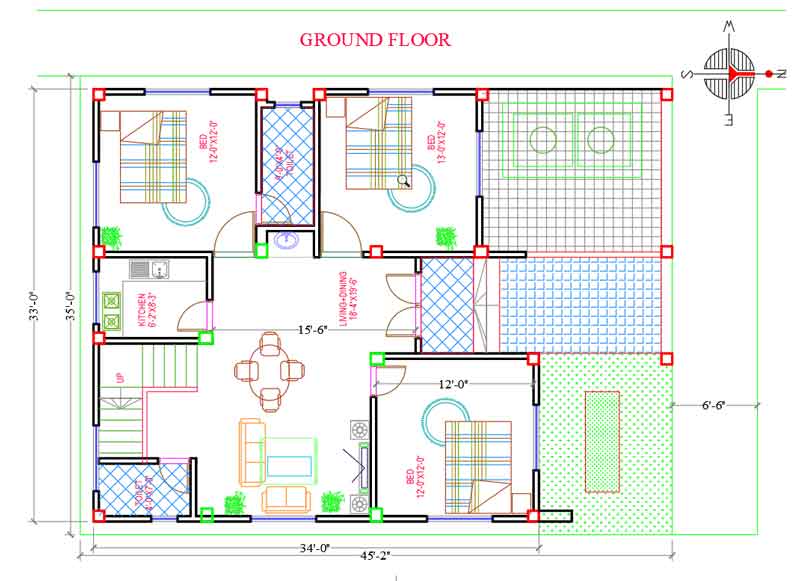
Using our referenced design for a dual-unit-per-floor model, let’s explore how a high-quality, practical floor plan is structured.
Visual Insight: Panel 3 “TYPICAL FLOOR LAYOUT (UNITS A & B)” gives a precise breakdown of the internal arrangement of Unit A and Unit B. This plan is highly optimized, minimizing waste while maximizing utility.
Public Zones (Living/Dining): Upon entry, modern apartments open into large, open-plan living and dining areas. These are the social hearts of the unit. They must be spacious, bright, and offer connection to external spaces like balconies.
Private Zones (Bedrooms): Bedrooms are clustered for privacy. Optimal design avoids opening bedrooms directly off a common corridor; instead, they should access from a smaller ‘foyer’ zone or a sub-corridor within the unit. Every bedroom must have a window.
Utility Zones (Kitchens/Toilets): Kitchens and Toilets are the most resource-intensive and expensive spaces to build. Their position must optimize piping and drainage while ensuring ventilation.
Visual Insight: Panel 4 “KEY DESIGN DETAILS: KITCHEN & TOILET” zooms in on these specific, complex rooms. Detailed 3D isometric cutaways show the efficient arrangement. The text lists features: “MODERN CABINETS,” “QUARTZ COUNTERS,” “VENTILATION”. For the toilet: “MODERN FIXTURES,” “TILE SELECTION,” “VENTILATION”.
Notice how in the typical floor plan (Panel 3), the toilets and kitchens are often located near internal light wells or external walls to provide natural light and exhaust.
Part 5: Materiality and Modern Finish Selection
A building’s design must be translated into physical form through material and finish choices. For a modern multi-unit building, durability, maintainability, and aesthetic appeal are key.
Visual Insight: Panel 4 (Kitchen/Toilet) and Panel 5 “TYPICAL FLOOR (3D ISOMETRIC)” are critical here. Panel 5 uses high-quality textures to visualize the final space.
Flooring Materials:
-
Main Areas: Large-format polished porcelain tiles or durable laminate flooring offer clean lines and are easy to maintain.
-
Wet Areas: Anti-skid ceramic tiles are essential for toilets and balconies.
Wall Finishes:
-
Standard Wall: A high-quality smooth putty finish with premium plastic paint. Clean white walls (as seen in the visualization) are contemporary and maximize light.
-
Accent Walls: Feature walls (e.g., in the living area or master bed) can use textured paints, wallpaper, or natural stone cladding.
Joinery and Glazing:
-
Door Frames: Teak wood for main doors and engineered wood/WPC for internal doors.
-
Windows: Large aluminum-framed, sliding or casement windows (matching the ‘realistic frames’ requirement from the visualization prompt) with clear, tempered glass. This maximizes the ‘light and air’ priority.
Part 6: Integrating Modern Amenities and Sustainability (G+5 Scale)
Even on a 6-storey scale, modern buildings can integrate smart, sustainable features that enhance value and reduce operational costs.
Sustainability on a Plot Scale:
-
Roof Gardens: Converting the concrete roof into a green terrace can significantly reduce the building’s thermal mass (lowering cooling loads) while providing a recreational space.
-
Solar Power: Solar panel arrays on the rooftop can provide power for common area lighting, minimizing costs.
Visual Insight: Panel 6 “BUILDING MASSING & SUSTAINABILITY” of our series is our dedicated diagram. It shows a full 6-storey building section. It has been enhanced with two clear, actionable sustainability features:
Green Roof Systems for thermal insulation and leisure.
Rooftop Solar Arrays for communal energy. The text explicitly lists: “CONSIDERATIONS: BNBC Compliance, Light Wells, Thermal Mass.” This panel demonstrates how modern visualization can validate sustainable ideas early in the design process.
Modern Amenity Requirements:
-
Rooftop Community Hall: A shared space for small events is now a highly sought-after amenity.
-
Ground Floor Utilities: Secured guard rooms, driver’s waiting areas, and a garbage compacting zone are all standard for modern buildings.
-
Secured Access: Video intercoms and access control systems for the lobby.
Part 7: The Value of Realistic 3D Visualization
For any developer, the ‘sell’ is essential. In Bangladesh, where many projects are pre-sold or built via a landowners’ agreement, visualization is not just an architect’s tool; it’s a vital commercial asset.
Visual Insight: The entire sequence from Panels 1 to 6 illustrates this. It moves from conceptual site diagrams to precise 2D plans, then to detailed 3D rooms, and finally to the full, premium 3D Isometric Visualization of the typical floor (Panel 5). This detailed progression, culminating in photorealistic materials, natural lighting, and soft shadows, provides a crystal-clear vision of the final product. A presentation like this, complete with labeled rooms and magazine-quality finishes, allows stakeholders to sign contracts with confidence.
Conclusion
Designing and building a 6-storey apartment complex in Bangladesh is a complex, high-stakes endeavor that requires a synthesis of efficient floor planning, strict code compliance, durable materiality, and strategic amenity integration. By prioritizing light and air, leveraging technology (like elevators, light wells, and modern visualization), and adhering to regulatory best practices, developers can create not just a physical asset but a vibrant, functional community that commands high value in the modern urban landscape. We hope this guide, and the detailed visualization process it references, inspires and supports your next vertical project.